
TRANSFORM ARCHITECTURAL VISIONS INTO IMMERSIVE REALITIES!



COURSE OVERVIEW.
This course offers a focused introduction to virtual reality environment creation and spatial storytelling using Unreal Engine for Meta Quest 3, with an emphasis on virtual tours, architecture, museums, and cultural experiences. Students will learn how to design immersive VR walkthroughs, implement comfort-friendly navigation, create interactive materials and artifacts, and build information-driven environments that support storytelling and user engagement.
The course also covers VR user experience design, including world-space UI, guided and free-roam tour systems, narration, and environmental storytelling through lighting and sound. Finally, students will learn how to optimize and deploy high-quality, standalone VR experiences for Meta Quest devices, culminating in a self-directed final project that results in a professional, portfolio-ready virtual tour suitable for museums, architectural presentations, and cultural institutions.
Learning Language: choose to learn in Arabic or English
Learning type: Hybrid (Online live classes/Labs + Pre-recorded material)
Duration: 3 months
PROGRAM CURRICULUM.
This course provides a comprehensive introduction to virtual reality environment creation and spatial storytelling using Unreal Engine for Meta Quest 3. Students will begin by learning the foundational principles of VR development, including project setup, XR workflows, navigation systems, and comfort-focused interaction design tailored specifically for architectural and cultural spaces.
The course then focuses on building interactive virtual tour environments, teaching students how to transform static architectural or exhibition spaces into immersive VR experiences. Participants will learn how to implement intuitive navigation, interactable artifacts, and responsive materials, enabling users to explore spaces, inspect objects, and engage with architectural and curatorial elements in a natural and meaningful way.
Students will also explore interactive materials and environmental storytelling, learning how to create dynamic surfaces, material variations, and visual states that communicate narrative, historical context, or design intent. Through the use of lighting, soundscapes, and spatial composition, students will develop emotionally engaging environments that guide visitor attention and enhance storytelling within virtual museums and architectural walkthroughs.
A significant portion of the course is dedicated to VR user experience design and guided tour systems, including the creation of world-space UI, information layers, narration triggers, and guided or free-roam tour modes. Students will learn best practices for presenting information in VR without breaking immersion, ensuring accessibility and comfort for a wide range of users.
Finally, the course addresses optimization and deployment for standalone VR headsets, teaching students how to balance visual quality and performance for Meta Quest devices. Topics include lighting strategies, asset optimization, performance budgeting, and packaging experiences for professional delivery in museums, exhibitions, and client presentations.
Final Project:
You will have the opportunity to develop a self-chosen project, which will help you build your portfolio with guidance from the instructors through mentorship sessions. This project will provide you with real-world context, allowing you to learn how to address technical challenges and how to find solutions before entering the job market.
The detailed curriculum will be finalized and released soon!
LEARN METHOD.
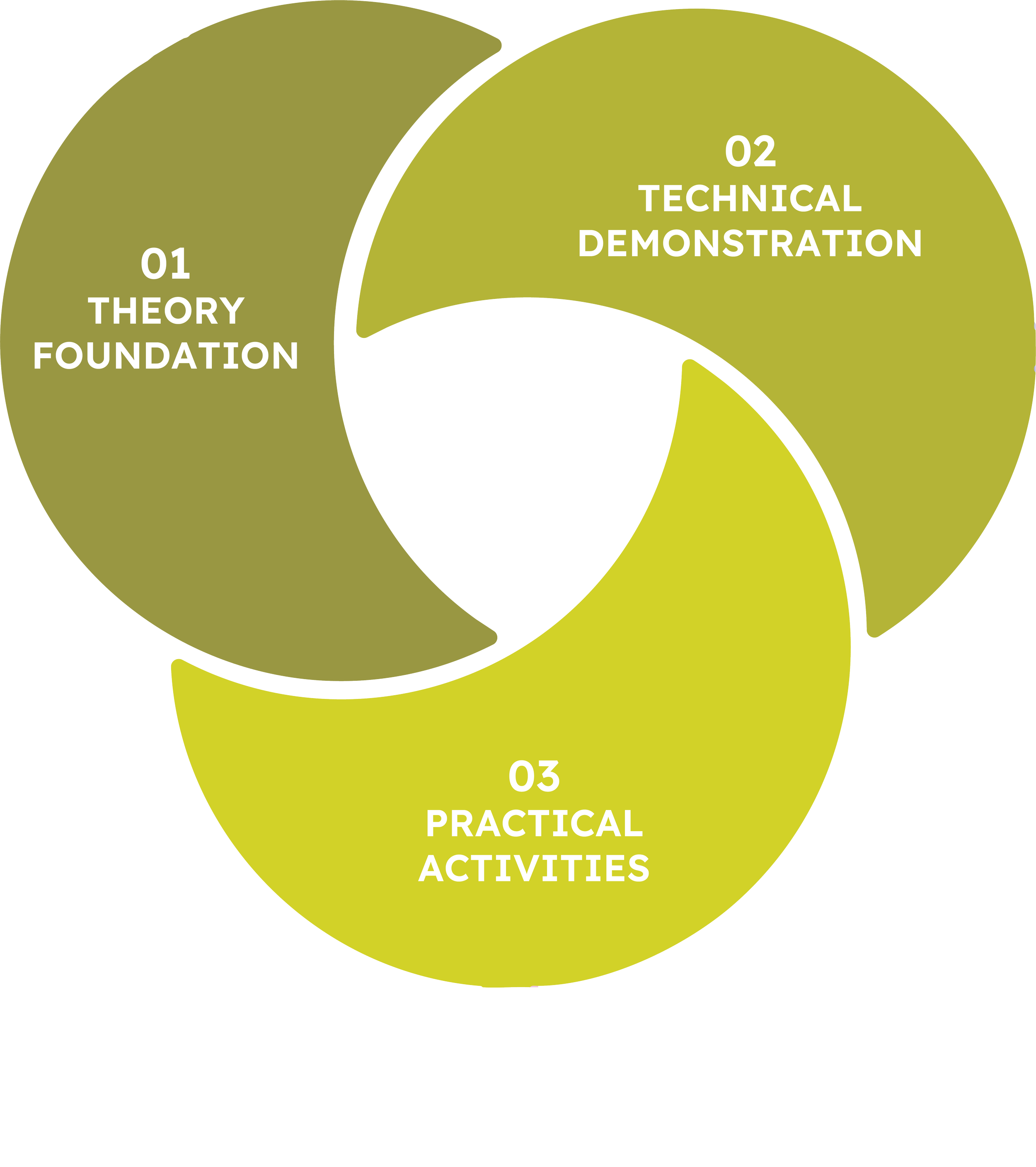
NOETA's holistic education fosters deep understanding and practical skills through a unique learning cycle integrating theory, demos, and hands-on projects, delivered via a flexible hybrid model.
This comprehensive learning cycle is powered by our Hybrid Learning Model, which combines the best of both worlds:
Live Instruction: Engage in real-time interactions with instructors, receive immediate feedback, and participate in dynamic discussions.
Live Lab Sessions: Get direct support and project corrections from instructors during dedicated lab sessions.
Pre-recorded Materials: Access flexible, self-paced learning resources that complement live instruction. Review concepts, revisit demonstrations, and learn at your own speed, maximizing your learning potential.
MEET YOUR INSTRUCTOR
MAHMOUD ALKAWADRI
Founder of NOETA Academy, Mahmoud Alkawadri is a multilingual CGI/Realtime Artist, Architect, and Educator with 19+ years of experience across VFX, gaming, animation, and architectural visualization.
Trained in architecture (Damascus University, TU Berlin) and digital art (Arena Animation), he honed his VFX skills through a two-year mentorship with Emmy-winning artist Allan McKay. Mahmoud teaches 3D real-time, Unreal Engine, and AI. An Unreal Engine Authorized Instructor and curriculum designer, he also partners with Epic Games, Incas Training, and Vertex School, teaching animation, virtual production, game development, and archviz. He has provided professional training at Wave Academy, Indisoft, and Deutsche Welle.


-
Yes! Students interested in taking courses, may benefit from a conversation with an Admissions Advisor. Advisors can help you choose courses that are designed to meet your specific goals, taking into consideration your current skill level, weekly schedule, timeline, and budget. If you'd like help choosing courses, please contact us.
-
Courses will generally span 24 weeks in length, meeting twice per week on a scheduled day and time. Some courses may be offered in a variety of schedule formats. Please check the course schedule for course schedule information.
-
Yes. NOETA’s courses are High-level, for-credit classes. These courses include classwork, homework, and grades.
-
If you are unable to attend a class session, simply notify your instructor. Absences may not exceed 30% of the total course time. Students who do not maintain 70% attendance may receive an unsatisfactory grade.
-
Each class session is scheduled within a 2-hour block. A class will typically consist of homework review, a short Q&A session, and lecture.
-
Due to the advanced nature of our curriculum and high volume of coursework, it is recommended that full-time students focus primarily on their studies while attending.
-
You should expect to spend 9 to 10 hours a week on online-class coursework and homework, per class.
-
NOETA is sensitive to the fact that a great deal of information is given in course lectures. Students are encouraged to audio record lectures with instructor permission only, but please note that students must not film lectures, either with a camera or their cell phones, under any circumstances.